
The Ant That Refused to Die!!
Author: Martin Munyao Muinde
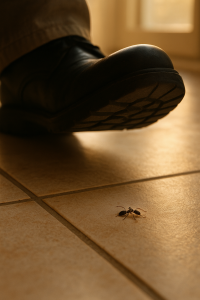
The afternoon light filtered through my window as I settled into Chapter Seven of The Psychology of Money. Morgan Housel’s words about patience and resilience filled my mind when movement on the floor caught my eye—a tiny sugar ant, meandering across the tiles with no particular urgency.
Without hesitation, without malice, I lifted my foot and brought it down. A casual act of termination. The ant’s journey ended beneath my sole, or so I believed. I returned to my book, to Housel’s insights about weathering storms and long-term thinking, completely forgetting the small life I’d just extinguished.
Twenty minutes passed. Maybe thirty. Then, in my peripheral vision, something impossible happened.
The ant moved!
At first, I thought it was a trick of light, or perhaps a different ant. But no—this was the same crushed creature, now attempting what seemed utterly futile. Its movements were agonizingly slow, almost imperceptible, like someone waking from a coma and remembering, one muscle at a time, how to live.
I set down my book and knelt closer, transfixed. The ant’s body was clearly damaged, its movements uncoordinated, but there was something profound in its struggle. It wasn’t giving up. It wasn’t accepting the death sentence I’d carelessly delivered. Every twitch, every millimeter of progress was a declaration: I’m still here.
When I reached toward it, the ant’s pace quickened—survival instinct overriding its injuries. In that moment, I saw something I hadn’t expected: a mirror. How many times had life stepped on me? How many crushing defeats had I accepted as final? How often had I stayed down when something within me still flickered?
I carefully scooped the ant onto a piece of paper and carried it outside, placing it gently on the soil near a plant. As it slowly navigated away from my shadow, I realized the irony wasn’t lost on me. Here I was, reading about resilience in financial markets and human behavior, while a creature no bigger than a grain of rice gave me the most powerful lesson of the day.
That ant should have been dead. By all reasonable measures, it was dead. I had felt it beneath my foot, seen its motionless body on the floor. Yet something—call it instinct, call it life force, call it whatever you wish—refused to accept that conclusion. The ant chose, in whatever way its tiny nervous system makes choices, to try.
We humans complicate resilience. We dress it up in motivational quotes and self-help strategies, forgetting that at its core, resilience is simple: it’s the refusal to accept the crushing weight as final. It’s the sluggish first movement after devastation. It’s trying when trying seems impossible.
Second chances aren’t always given; sometimes they’re taken. That ant didn’t wait for permission to live again. It didn’t ask if recovery was possible. It simply began, however broken, however slowly, to move forward.
As I watched it disappear into the garden, I thought about my own crushed dreams, my defeated ambitions, the parts of myself I’d left for dead on life’s floor. The ant reminded me that sometimes the most profound victories aren’t the ones where we emerge unscathed. Sometimes they’re the battles where we rise from what should have destroyed us, move when movement seems impossible, and refuse—absolutely refuse—to let the world’s weight be the final word.
That evening, I finished the chapter on resilience with new eyes. Morgan Housel wrote about markets recovering from crashes, about fortunes rebuilt from ruins. But the sugar ant taught me something more fundamental: life isn’t about avoiding the crush. It’s about what you do in the moments after, when everyone—including yourself—thinks it is over.
It’s about moving, even when you shouldn’t be able to.